Buy exactly what you need
Running low on one compound? No need to replace the whole kit. Buy individual top-up packs and carry on where you left off.
All compounds are the same high-quality, dry powder form as found in the kit — pre-weighed so you know exactly how much you’re getting.
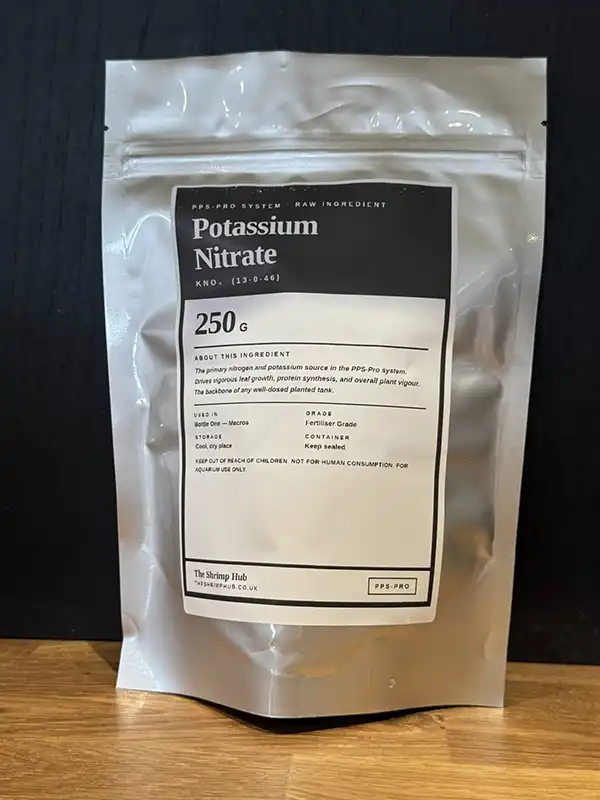
Potassium Nitrate
KNO₃ · 250g · NPK: 13-0-46Potassium Nitrate is the primary nitrogen source in the PPS-Pro macro bottle. Nitrogen is the nutrient plants use most — it drives leaf growth, stem strength, and that deep green colour everyone wants.
Without enough nitrogen, plants go pale and growth slows right down. This is usually the first deficiency you’ll notice, and the easiest to fix.
250g is the standard amount used in one full PPS-Pro macro mix. When this runs out first, just grab another pack and top up your macro bottle.
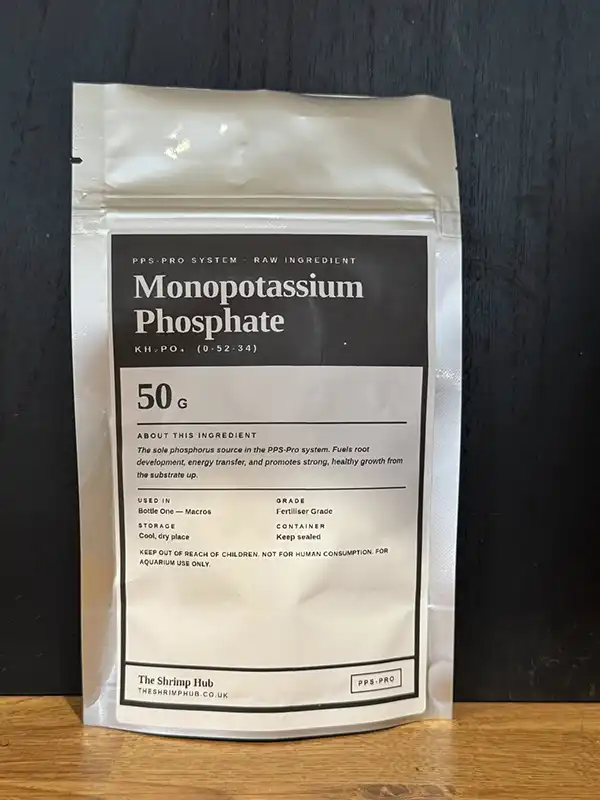
Monopotassium Phosphate
KH₂PO₄ · 50g · NPK: 0-52-34Monopotassium Phosphate (MKP) supplies phosphorus — the nutrient responsible for root development, flowering, and healthy cell structure in aquatic plants.
You use much less of it than nitrogen or potassium, which is why the pack size is smaller. 50g is the standard amount for one full PPS-Pro macro mix.
Phosphorus deficiency shows up as slow growth and reddish or purplish tints on leaves. A little goes a long way with this one.
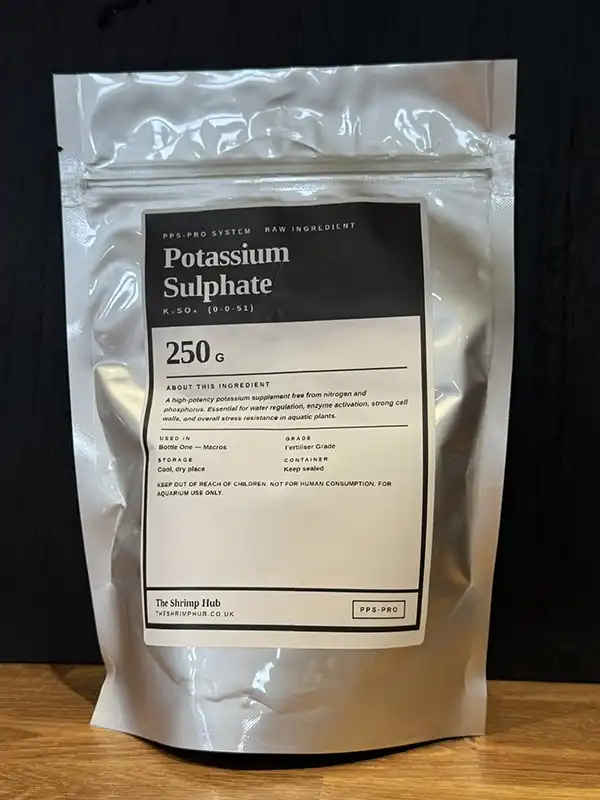
Potassium Sulphate
K₂SO₄ · 250g · NPK: 0-0-51Potassium Sulphate provides potassium without adding nitrogen or phosphorus. That makes it ideal for fine-tuning your potassium levels independently, or for tanks where fish waste is already contributing nitrogen.
Potassium plays a role in enzyme activation, water regulation, and overall plant resilience. Plants deficient in potassium develop yellowing at leaf edges and holes in older leaves.
250g is the standard amount for one full PPS-Pro macro mix. The sulphate form adds no unwanted chloride — better for shrimp and sensitive livestock.
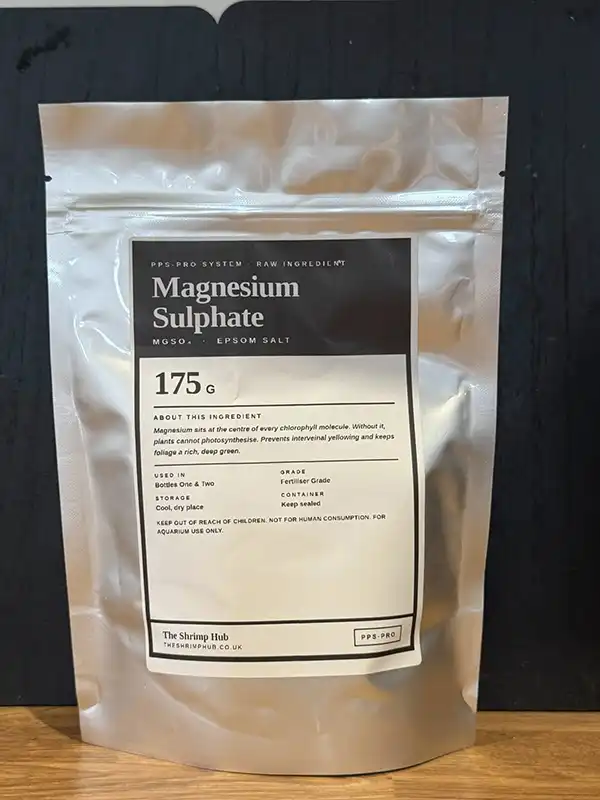
Magnesium Sulphate
MgSO₄ · 175gMagnesium Sulphate is essential for chlorophyll production. Without magnesium, plants can’t make chlorophyll — and without chlorophyll, they can’t photosynthesise regardless of how much light they have.
Magnesium deficiency is one of the most common in planted tanks, especially in soft water areas. You’ll see it as interveinal chlorosis — yellowing between the leaf veins while the veins themselves stay green.
175g is the standard amount used in one full PPS-Pro macro mix.
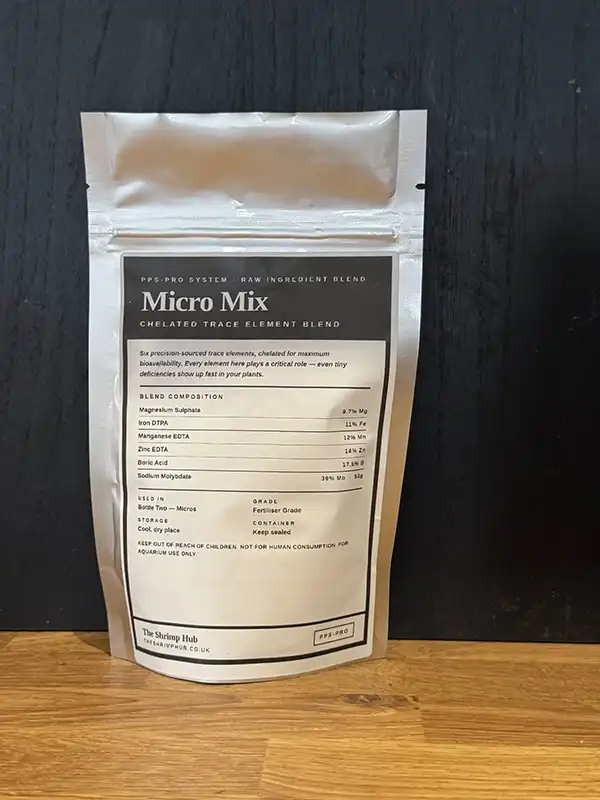
Copper-Free Micro Mix
Trace element blend · Copper-freeOur Micro Mix provides the trace elements that plants need in small but critical amounts — iron, manganese, boron, zinc, and molybdenum. Completely copper-free, making it safe for shrimp, snails, and all invertebrates.
The most visible effect of micronutrient deficiency is pale new growth — especially iron deficiency, which causes young leaves to emerge yellow while the veins stay green.
In PPS-Pro, micros are kept separate from macros and dosed from their own bottle. This prevents interactions between compounds that can reduce effectiveness.
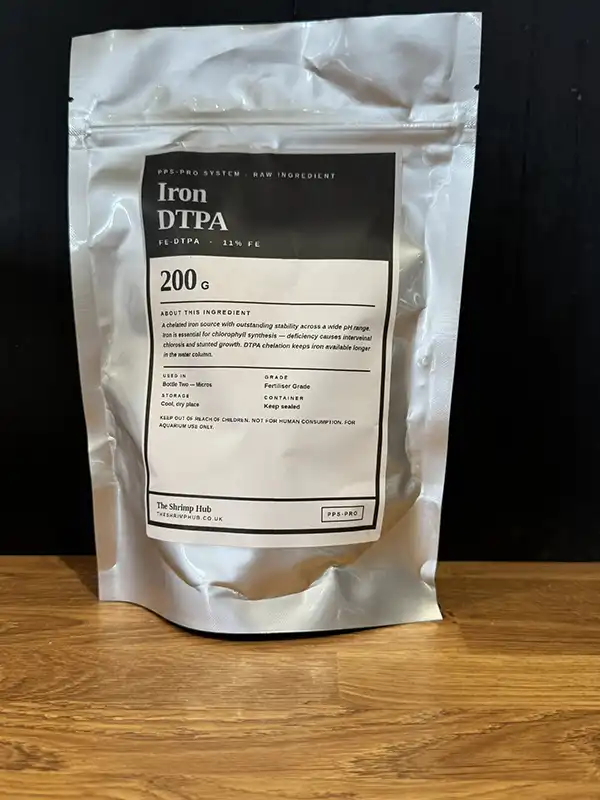
Iron DTPA 11%
Fe-DTPA · Available in 50g & 200gIron DTPA is a chelated iron supplement — the most reliable form of iron you can add to a planted tank. Chelation keeps the iron dissolved and available to plants rather than immediately precipitating out of the water column.
Iron is one of the most common deficiencies in planted tanks. You’ll see it as yellowing or pale new growth on fast-growing stem plants and red varieties. DTPA chelation stays stable up to pH 7.5 — unlike standard EDTA which breaks down above pH 6.5 and is largely ineffective in most UK tap water.
Can be added to your micro bottle alongside the Micro Mix, or dosed separately if you want more control over iron levels independently.
Start with the full kit
If you haven’t fertilised before, our full kit is the easiest starting point. All five compounds, plus two mixing bottles and two syringes — everything in one box, nothing to figure out separately. Free UK delivery.
View Full Kit — £39 →