
Daily vs Weekly Dosing: Which Is Better?
Big doses once a week, or a little every day? Here’s how the two approaches compare and which suits your tank.
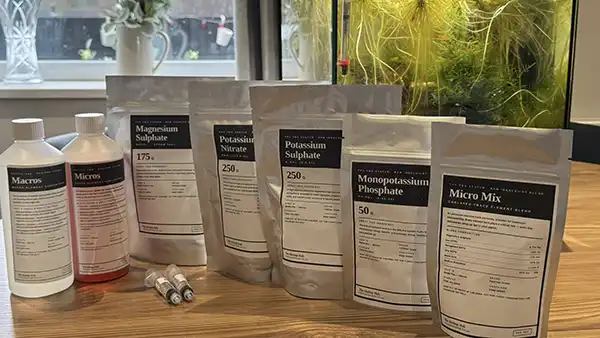
There are two main ways to feed a planted tank. Weekly or three-times-a-week methods, such as Estimative Index (EI), add a generous amount and reset the tank with a big water change every week. Daily micro-dosing methods, such as PPS-Pro, add a small, measured amount each day so plants use it as fast as it goes in. Both grow plants. They suit very different tanks and lifestyles.
How weekly dosing works
Methods like EI deliberately add more food than plants need, so nothing ever runs short. Because the surplus builds up, you do a large water change, usually 50%, every week to reset. It’s popular in high-tech tanks with strong light and CO₂, where plants grow very quickly.
How daily dosing works
Daily micro-dosing adds a small amount each day, matched to what plants use. Nutrients stay low and steady rather than spiking and dropping. Because little builds up, you change water when a TDS pen tells you to, rather than on a fixed weekly schedule.
| Daily (PPS-Pro) | Weekly (EI) | |
|---|---|---|
| How often you dose | Every day, 20 seconds | 2–3 times a week |
| Water changes | When TDS rises (often every 2–4 weeks) | 50% every week, without fail |
| Nutrient levels | Low and steady | High, reset weekly |
| Best for | Low to high light, shrimp tanks | High light with CO₂ |
| Shrimp friendly | Yes, very | Less so: big swings each week |
| Food used | Less | More |
Why daily suits most UK tanks
Stable water
Shrimp and many fish prefer water that doesn’t change much. Daily dosing avoids the weekly spike-and-reset cycle.
Fewer water changes
No compulsory 50% change every week. You change water when the numbers say so.
Less algae risk
There’s never a big surplus sitting in the water, which keeps algae under control in tanks without strong CO₂.
Uses less food
You only add what plants need, so a kit lasts longer.
Daily dosing sounds like a chore but takes about 20 seconds. Keep the bottles and syringes by the tank and it becomes automatic. A dosing pump can do it for you if you’d rather.
When weekly might suit you better
If you run a high-tech tank with very strong light, pressurised CO₂ and fast stem plants, and you enjoy large weekly water changes, EI works well. If you’re away a lot and can’t dose daily, a dosing pump is usually a better answer than switching method.
Switching from weekly to daily
Do a large water change to reset, then start daily dosing at the standard 1ml per 10L of each solution, or half that in low-light or shrimp tanks. Buy a TDS pen and note your tap water reading. Change around half the water when the tank reads about 100 µS/cm above your tap. Full details are in how much aquarium fertiliser should I use?.
Quick answers
Is it better to dose fertiliser daily or weekly?
For most tanks, daily. It keeps nutrients stable, is kinder to shrimp and needs fewer water changes. Weekly suits high-tech tanks with strong light and CO₂.
What happens if I miss a day of dosing?
Nothing serious. Just carry on the next day. Don’t double up. Missing several days in a row is when plants start to suffer.
Can I use a dosing pump?
Yes. A dosing pump is perfect for daily dosing and means you never forget.
Do I still need water changes with daily dosing?
Yes, but less often. Use a TDS pen and change water when it rises about 100 µS/cm above your tap water.
Products mentioned in this guide
Everything to start dosing on day one: pre-measured macro and micro compounds, two 500ml bottles, two dosing syringes and a full dosing guide.
Already mixedMacro and micro solutions already dissolved and ready to dose. No preparation at all.
Shrimp safeThe copper-free trace element blend for your micro bottle. Safe for shrimp, snails and other invertebrates.
Copper-free aquarium plant food.
Dose on day one.
Pre-measured compounds, bottles, syringes and a full dosing guide. Shrimp safe, made in the UK, free UK delivery on every order.
Everything you need to get the most from your planted aquarium.
