What Is Aquarium Plant Food and Do My Plants Need It?
Plants need feeding just like fish do. Here’s what aquarium plant food is, what it contains, and how to tell whether your tank needs it.
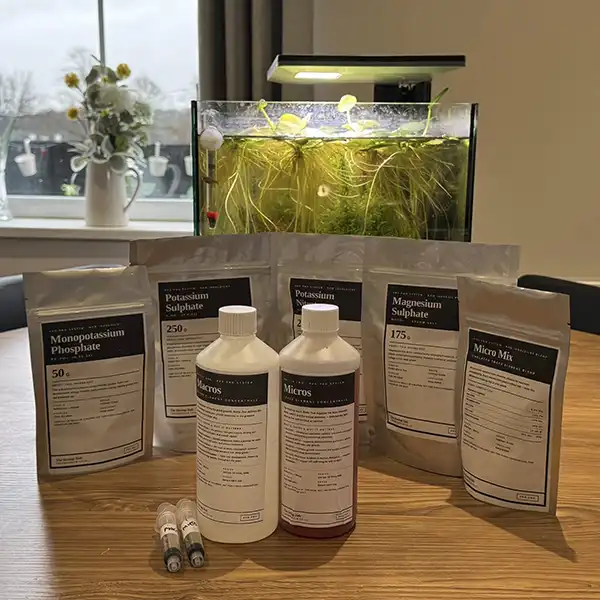
Aquarium plant food (also called aquarium fertiliser) is a set of nutrients that you add to the water so live plants can grow. In nature, rivers and lakes are constantly topped up with nutrients from soil, rain and decaying leaves. A glass box isn’t. Once your plants have used up what’s in the substrate and the fish waste, growth slows, leaves fade, and algae steps in to take the light your plants are no longer using.
What’s in aquarium plant food?
Every plant food is built from two groups of nutrients. Plants need both, just in very different amounts.
Macronutrients
Needed in the largest amounts: nitrogen, phosphorus and potassium, plus magnesium and sulphur. These drive new leaves, stems and roots. In the Aquafertz system they go in your macro bottle.
Trace elements
Needed in tiny amounts but just as important. They help plants make chlorophyll and use the light properly. They go in your micro bottle, chelated so they stay available in the water.
Carbon is the other big one. Plants get it from CO₂ dissolved in the water, which is why high-tech tanks inject CO₂. Low-tech tanks rely on what’s naturally in the water, so they grow slower and need less food.
Do my aquarium plants need it?
Almost every planted tank benefits from some plant food. The question is how much. Use this quick check:
| Your tank | Needs plant food? |
|---|---|
| A few slow plants (anubias, java fern), low light, lots of fish | A little: a low daily dose keeps leaves green |
| Mixed planted tank with a standard LED | Yes, daily at the standard dose |
| Fast stem plants or carpets, strong light, CO₂ | Yes, plenty: plants will starve without it |
| Shrimp tank with moss and a few plants | Yes, at a low dose and copper-free only |
Fish waste supplies some nitrogen and phosphorus, but almost never enough potassium, magnesium or trace elements for healthy plants.
Signs your plants are hungry
Pale or yellowing leaves
Older leaves yellowing first usually means the macros are running short. New leaves coming in pale points to a trace shortage. See our yellow leaves guide.
Growth has stalled
Stems that stop growing, or new leaves that are smaller than the old ones, are a classic sign that the water has been stripped of nutrients.
Holes and see-through patches
Small pinholes in older leaves often mean potassium is low. More on that in our guide to pinholes and brown patches.
Algae creeping in
Weak, hungry plants can’t compete. Algae takes over the spare light and nutrients. Feeding the plants properly is often the fix, not the cause.
Types of aquarium plant food
You’ll see three main types in UK shops. All-in-one liquids are convenient but you pay mostly for water, and you can’t adjust one nutrient without changing them all. Root tabs feed plants through the substrate and suit heavy root feeders such as swords and crypts. Dry compounds, like the Aquafertz PPS-Pro system, are the individual nutrients you dissolve yourself. They cost far less per dose and let you adjust each nutrient separately.
We compare these in detail in liquid vs powder plant food and root tabs vs liquid plant food.
Plants can’t store much food. A small daily dose keeps nutrients steady, so plants grow evenly and there’s never a big surplus sitting in the water for algae.
How to start
Start at the standard Aquafertz dose of 1ml of macro and 1ml of micro per 10 litres, once a day, before the lights come on. Halve it for low-light or shrimp-only tanks. Watch the plants for two to three weeks, then adjust. Our dosing guide has a tank-size table and tells you exactly what to change if something looks off.
Quick answers
Is aquarium plant food safe for fish?
Yes. Used at the recommended dose, plant food is safe for fish. The nutrients are the same ones fish waste and tap water already contain, just in the balance plants need.
Is aquarium plant food safe for shrimp?
Only if it’s copper-free. Copper is toxic to shrimp and snails even at low levels. Aquafertz is copper-free and made for shrimp tanks.
Can I use house plant food in my aquarium?
No. House plant feeds often contain urea, ammonia and copper, which can harm fish and shrimp and feed algae. Always use a food made for aquariums.
Do I need plant food if I have aquasoil?
Aquasoil feeds roots for the first few months, then runs low. Most tanks need water-column feeding from the start, and definitely after three to six months.
Products mentioned in this guide
Everything to start dosing on day one: pre-measured macro and micro compounds, two 500ml bottles, two dosing syringes and a full dosing guide.
Already mixedMacro and micro solutions already dissolved and ready to dose. No preparation at all.
Shrimp safeThe copper-free trace element blend for your micro bottle. Safe for shrimp, snails and other invertebrates.
Copper-free aquarium plant food.
Dose on day one.
Pre-measured compounds, bottles, syringes and a full dosing guide. Shrimp safe, made in the UK, free UK delivery on every order.
Everything you need to get the most from your planted aquarium.
